How 2D Animation Is Made: A Technical Walkthrough for Non-Animators
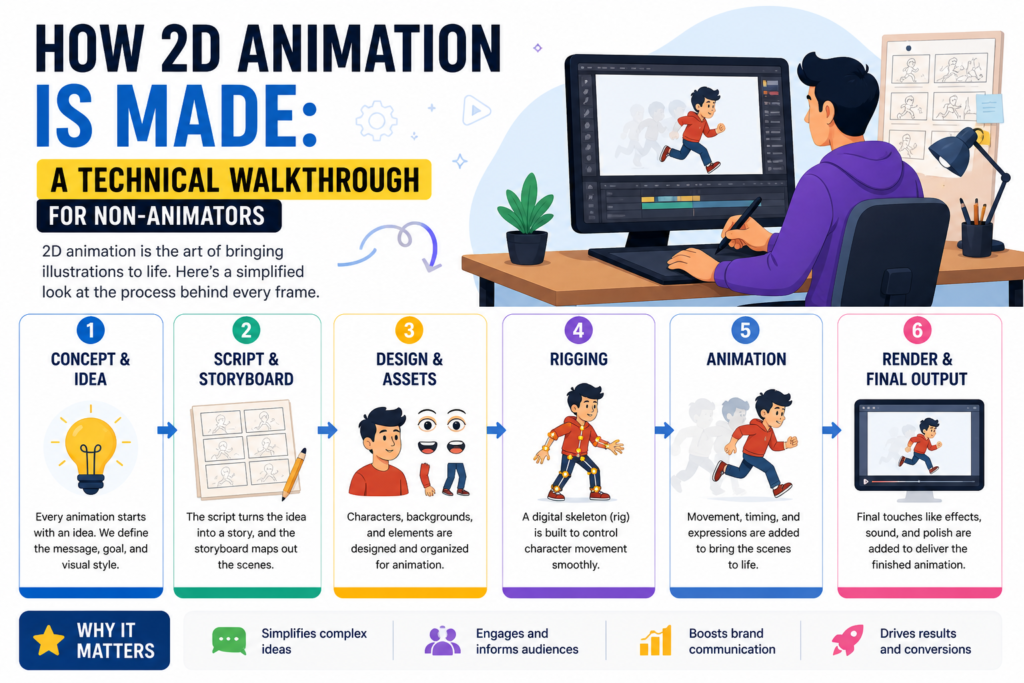
Most people who commission animation for their brand have never seen the inside of an animation production. They know what they want the final video to look and feel like — but the process that gets from a creative brief to a finished, rendered animation is largely invisible to them. That gap in understanding creates problems: unclear feedback, misaligned expectations, avoidable delays, and budget surprises. This walkthrough demystifies the 2D animation production process completely. It is written for business owners, marketing leads, and brand managers — not for animators. By the end, you will understand every phase of how a 2D animation is made, what happens in each one, what decisions you are responsible for as a client, and what to expect from your animation studio at each stage. Understanding how animation is made does not just satisfy curiosity — it makes you a significantly better client, which leads directly to better work and fewer revisions. The Six Phases of 2D Animation Production A professional 2D animation project moves through six sequential phases. Each phase builds on the last, and approval at each stage is required before the next begins. This linear structure is not arbitrary — it exists because changes become exponentially more expensive and time-consuming the further into production they occur. A script change costs one hour. The same change at the animation stage costs days. Phase 1: Discovery and Strategy Before any creative work begins, the production team needs to understand what the animation is for. This phase involves a kickoff conversation or brief review session in which the studio gathers the information needed to make strategic creative decisions: the goal of the video, the target audience, the key message, the tone, the distribution channels, and any existing brand assets the animation must align with. For experienced clients with clear briefs, this phase is short — a single meeting and a brief review. For clients who are new to animation or whose goals are not yet fully defined, the discovery phase may involve deeper strategic consultation to ensure the project is set up for success before any creative resources are committed. What you are responsible for in this phase: providing clear answers to the studio’s brief questions, sharing brand assets (logo files, brand guidelines, color palette, typography), and identifying the key stakeholders who will be involved in approval decisions throughout the project. Phase 2: Scriptwriting The script is the most important single document in any animation project. Every visual, every scene, every moment of the final animation is a direct expression of decisions made in the script. A weak or poorly structured script cannot be rescued by excellent animation — and a strong script makes every subsequent phase easier, faster, and cheaper. A professional animation script is not the same as a creative essay or a marketing copy document. It is a structured production blueprint that specifies exactly what is said (the voiceover or on-screen text), the emotional arc of the video, the pacing, and — in many studios — directorial notes about what should be visualized in each section. For a 60-second animation, the script is approximately 150 to 160 words of voiceover narration, plus production notes. The Script Approval Decision Script approval is the single most consequential decision a client makes in an animation project. Once the script is approved and the project advances to storyboard, changes to the script require corresponding changes to the storyboard and potentially to the recorded voiceover — creating a cascade of revisions that can add significant time and cost to the project. Invest the time in getting the script right before approving it. What to look for when reviewing a script: Does it lead with the viewer’s problem or need, not with your company’s story? Does it reach the core value proposition within the first 10 to 15 seconds? Is the language clear to someone who knows nothing about your product? Is there a single, specific call to action at the end? Is the tone consistent with your brand’s voice? Phase 3: Storyboarding Once the script is approved, the production moves into storyboarding — the visual planning phase in which each scene of the animation is sketched out as a sequence of rough frames. A storyboard functions like a comic book version of the final animation: it shows what will appear on screen in each section, how characters and graphic elements are positioned, how scenes transition, and how the visual narrative maps to the script. Storyboards are produced in rough sketch form — not finished illustration. Their purpose is to establish compositional decisions and narrative flow before any refined artwork is created. This is the correct phase at which to give feedback on visual direction, scene structure, and the overall flow of the animation. Reading a Storyboard Effectively When reviewing a storyboard, focus on structure rather than finish quality. Ask yourself: Does the sequence of scenes tell the story clearly? Are the transitions between scenes logical? Does the visual emphasis in each frame support the corresponding script line? Is there anything in the script that is not accounted for visually? Are there visual elements or scenes that feel unnecessary or redundant? What you should not focus on at the storyboard stage: the quality of the illustration, the colors, the character design, or the level of detail. All of that comes in the next phase. Giving detailed illustration feedback at the storyboard stage is one of the most common client mistakes in animation production, and it creates confusion about which feedback is actionable at which phase. Phase 4: Visual Design and Asset Creation With the storyboard approved, the animation team moves into the visual design phase — the stage at which the style of the animation is finalized and all of the artwork required for production is created. This is typically the phase that takes the most calendar time, because every background environment, character design, graphical element, icon, and typographic treatment must be illustrated to final quality before animation