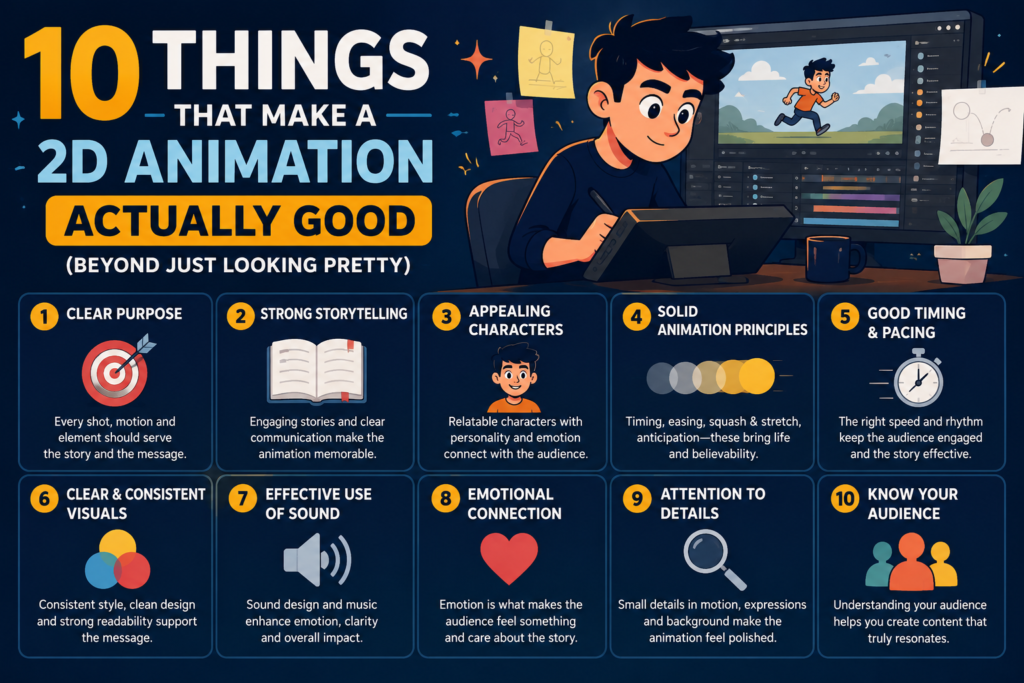
10 Things That Make a 2D Animation Actually Good (Beyond Just Looking Pretty)
Every element of a 2D animation — characters, environments, icons, typography, color — should feel as though it belongs to the same designed world. The color palette should be consistent throughout. The illustration style should not shift between scenes. The typography should follow the same system in every frame. The motion style — easing, timing, transition approach — should feel uniform rather than improvised. Visual inconsistency is one of the clearest signals of a studio working without adequate art direction, or a project that was produced under time pressure that compromised the design review process. Inconsistency breaks the viewer’s immersion in the content and creates a subliminal impression of a brand that does not have its act together. For brands investing in animation to build credibility, visual inconsistency in the animation is directly counterproductive. 5. Secondary Animation That Adds Depth Secondary animation refers to the supporting movement of elements that are not the primary focus of the scene: the slight sway of a character’s hair as they turn their head, the bounce of objects when they settle, the subtle idle breathing motion of a character waiting to speak. These elements are invisible when they are done well — they simply make the animation feel alive rather than mechanical. They are glaringly absent when they are not included. Secondary animation is one of the most reliable signals of production quality and animator skill, because it requires an understanding of how real physical systems behave and the ability to translate that understanding into deliberate motion decisions. Template-based and low-budget animation productions consistently omit secondary animation because it is time-consuming and requires craft that automated tools cannot replicate. Its presence in an animation reliably indicates a studio with experienced animators who care about quality beyond the primary motion. 6. Sound Design That Completes the Picture An animation viewed without sound is like a room with no furniture: the space is there, but it does not feel inhabited. Sound design — the combination of music, voiceover, and sound effects — does not simply accompany a 2D animation. It determines the emotional experience of watching it. The music bed sets the emotional register of the entire piece and primes the viewer’s emotional state before a word is spoken. Sound effects anchor specific visual moments — the click of a button, the arrival of a character on screen, the transition between scenes — and create a sense of physical reality in an otherwise flat visual world. The voiceover, when present, is the primary vehicle of meaning and must match the tone, pace, and personality of the brand with precision. An animation with poor sound design — generic stock music at the wrong tempo, voiceover that sounds recorded in a bathroom, sound effects applied arbitrarily — undermines visual quality that may have been excellent. 7. Deliberate Use of Color Color in 2D animation is not just aesthetic — it is communicative. The color palette of an animation determines its emotional temperature, its brand alignment, and its visual hierarchy. Warm colors advance and attract attention. Cool colors recede and suggest calm or professionalism. High saturation creates energy; low saturation suggests refinement. The relationship between colors — their contrast, their proportions, their dominant and accent roles — determines whether a composition feels balanced or chaotic, premium or generic. Good 2D animation uses color with intention: the most important element in any frame is given the highest color contrast or the most saturated tone to draw the eye. The color palette is consistent with the brand’s existing visual identity so the animation feels like a native brand expression. Accent colors are used sparingly enough that they retain emphasis value. And the palette is restrained enough — typically three to five primary colors — to create coherence rather than visual noise. 8. Clear Visual Hierarchy in Every Frame A well-composed animation frame communicates a clear visual hierarchy: the viewer’s eye lands on the most important element first, then moves to supporting elements in a logical sequence, then exits the frame having absorbed the intended information. This hierarchy is created through a combination of size, color contrast, placement, and motion — the elements that are largest, brightest, most centrally placed, or moving attract attention first. Poorly composed animation frames distribute visual attention democratically, treating all elements as equally important. The result is frames where the viewer does not know where to look, information is absorbed in random order, and the communication becomes muddled even if every individual element is well-designed. Composition discipline — ensuring that every frame has a clear visual anchor and a logical reading path — is one of the most transferable skills from graphic design to animation, and one of the most commonly neglected in lower-quality productions. 9. Transitions That Feel Designed, Not Default The way an animation moves between scenes is a design decision, not a technical default. A cut, a fade, a wipe, a push, a morph, a graphic match — each transition type carries a distinct emotional quality and a different level of visual disruption. Cuts are energetic and decisive. Fades are contemplative and connecting. Morphs are magical and suggest transformation. Graphic matches create visual wit and intellectual satisfaction. Good 2D animation uses transitions that are appropriate to the narrative and emotional context of each scene change. The transition from a problem scene to a solution scene should feel like a pivoting — a shift in energy that the transition style reinforces. The transition between two scenes of the same emotional register can be softer and less emphatic. Template-based animations use the same default transition throughout, which flattens the emotional texture of the piece and makes every scene change feel identical regardless of its narrative significance. 10. A Call to Action That Is Visually Earned The call to action at the end of an animation is the most commercially important single moment in the piece, and it should be designed accordingly. A good CTA arrives after the viewer has been given sufficient reason to act