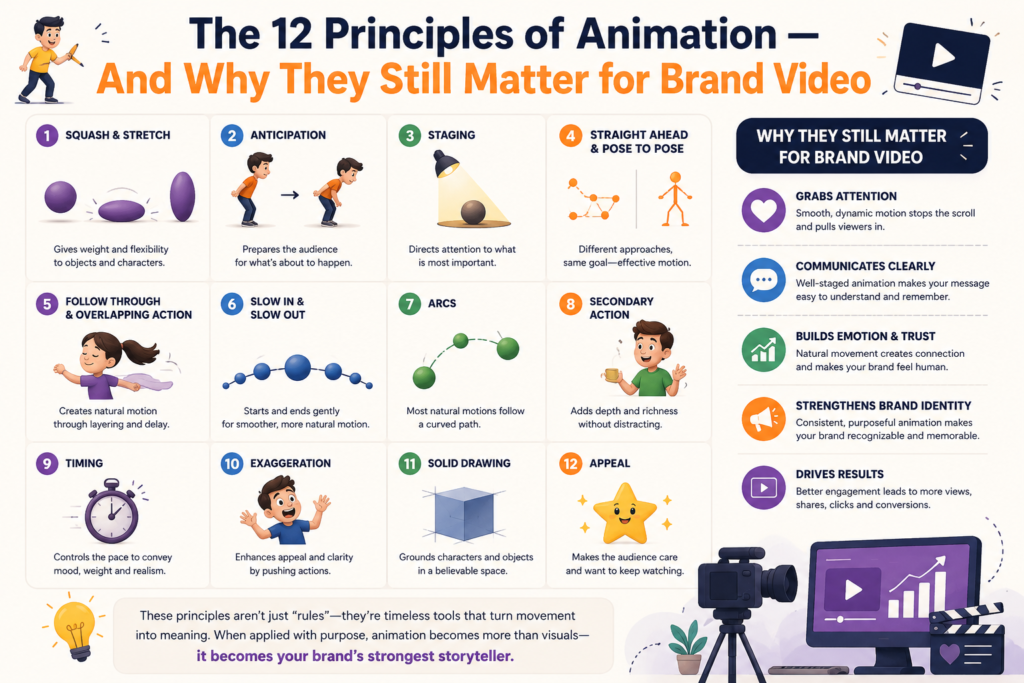
The 12 Principles of Animation — And Why They Still Matter for Brand Video
In 1981, two Disney animators named Ollie Johnston and Frank Thomas published a book called The Illusion of Life: Disney Animation. Inside it, they documented twelve principles that they and their colleagues had developed — largely through trial, error, and accumulated wisdom — over five decades of producing the most technically sophisticated and emotionally compelling animation the world had seen. Those twelve principles were not rules invented in a boardroom. They were observations about how human perception works — about why certain kinds of motion feel real, weight-bearing, and alive, and why other kinds feel mechanical, weightless, and dead. They described the conditions under which a drawn image creates the convincing illusion of a living, breathing, physically present being. Ninety years after they were first developed, in a world of digital drawing tablets, rigged character rigs, and AI-assisted animation tools, all twelve principles remain not just relevant but foundational. Every frame of every 2D animation your brand will ever publish is governed by them — whether the animator who produced it knows their names or not. Understanding them will help you evaluate animation quality, give better creative feedback, and make more informed decisions when choosing an animation partner. The 12 principles are not Disney’s rules. They are descriptions of how human perception responds to motion — and perception has not changed since 1935. Where the Principles Come From Walt Disney’s animation studio in the 1930s was doing something that had never been attempted before: producing feature-length animated films with characters whose emotional lives were rich enough to sustain a full narrative. To achieve this, the animators had to solve a fundamental problem — how do you make a drawing feel real? The answer they developed, piece by piece, is the twelve principles. They were not published in a training manual during the production years — they were implicit in the way the studio’s master animators worked, visible in the feedback they gave, and passed down through observation and apprenticeship. Johnston and Thomas spent years interviewing their colleagues, studying their own work, and articulating the principles explicitly for the first time in their book. Since publication, the principles have become the foundational technical and aesthetic framework of 2D animation education and practice worldwide. Every professional animation training program teaches them. Every professional animator applies them. And every commercial 2D animation your brand will ever commission is evaluated against them — consciously by the animator, unconsciously by the viewer. All 12 Principles — Explained for Brand Owners 1. Squash and Stretch Objects deform as they move, compressing in the direction of force and elongating in the direction of motion. A bouncing ball flattens when it hits the ground and stretches as it rises. This principle communicates weight and elasticity. Without squash and stretch, objects appear rigid and weightless — they move, but they do not feel like they have physical mass. With it, even a simple geometric shape convinces the viewer that gravity is acting on it. In brand animation: Used whenever a character or brand element needs to feel physical and real. A button that squashes when pressed feels interactive. A character who stretches toward an exciting discovery feels genuinely animated by emotion. The degree of squash and stretch is calibrated to the desired effect — subtle for realistic characters, exaggerated for comedic or high-energy animation. 2. Anticipation A movement is preceded by a preparatory motion in the opposite direction. A character bends their knees before jumping. A fist pulls back before swinging. Anticipation does two things simultaneously: it prepares the viewer’s eye for what is about to happen, and it makes the subsequent action feel more powerful. Without anticipation, motion feels abrupt and mechanical. With it, motion feels intentional and physically grounded. In brand animation: Used to prepare the viewer for significant visual events — a character about to deliver the key message, a graphic element about to appear, a scene about to transition. In brand animation, subtle anticipation signals communicate emphasis without requiring the viewer to consciously notice the preparation. 3. Staging The composition of each frame is arranged to direct the viewer’s attention to the most important element at each moment in time. Staging is the animation equivalent of the director’s shot choice in live film. Every visual decision — where characters stand, what is in the foreground versus background, what moves versus what stays still — is made to ensure the viewer’s eye lands on the right thing at the right moment. In brand animation: This is the principle most directly relevant to commercial effectiveness. A brand animation in which the CTA appears on screen but is not staged as the visual focal point of the final frames will convert less efficiently than one where the staging actively directs the viewer’s attention to the action prompt. Every frame of a commercial animation should be asked: where should the viewer be looking right now, and is this composition directing them there? 4. Straight Ahead and Pose to Pose Two different approaches to planning animated motion. Straight ahead means drawing each frame in sequence as the action unfolds. Pose to pose means planning the key positions first, then filling in the frames between them. These are production techniques as much as aesthetic principles, but their effect on the final animation is visible. Straight-ahead animation produces more spontaneous, fluid, and unpredictable motion. Pose-to-pose animation produces more controlled, precise, and consistent motion. In brand animation: Most commercial 2D animation uses a hybrid approach — pose-to-pose for structural clarity and consistency, with straight-ahead passes for expressive moments that need organic energy. Understanding this distinction helps clients recognize why spontaneous-feeling motion in a high-quality animation is a deliberate craft choice, not an accident. 5. Follow Through and Overlapping Action When a primary motion stops, secondary elements — hair, clothing, loose objects — continue moving momentarily before catching up. Different parts of a body start and stop moving at different times. This principle is what makes animated characters feel like they occupy physical