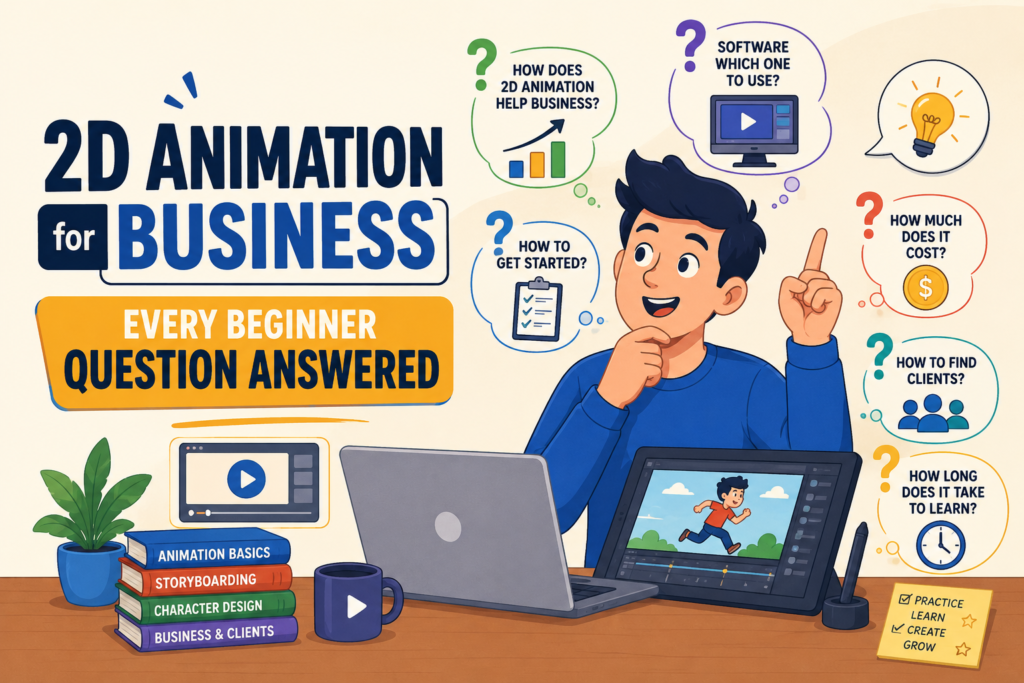
2D Animation for Business: Every Beginner Question Answered
Every business owner commissioning 2D animation for the first time arrives with the same cluster of questions. Some of them feel too basic to ask a studio directly. Others feel like they should already know the answer. Most of them are entirely reasonable, and every experienced animation studio has heard all of them. This FAQ collects every significant question a business owner might have about commissioning 2D animation — organized into categories, answered directly, and written without jargon. If you are brand new to animation for business, start at the beginning. If you have a specific concern, skip to the relevant category. Either way, by the end of this article you will have everything you need to approach an animation studio with confidence. There is no such thing as a question too basic to ask before commissioning animation. The questions you skip before the project starts become the problems you deal with during it. Category 1: Understanding 2D Animation (What It Is and How It Works) What exactly is 2D animation, and how is it different from 3D animation? 2D animation is the creation of motion in a flat, two-dimensional plane — characters, shapes, text, and graphic elements that move along horizontal and vertical axes without depth or three-dimensional volume. It is the oldest form of animation, rooted in hand-drawn cel animation, and it has evolved into a digital medium produced using software like Toon Boom Harmony, Adobe Animate, and After Effects. 3D animation creates objects and environments with full three-dimensional volume, depth, and shadow — the visual language of Pixar films and video game cutscenes. For most business communication needs, 2D animation is the more practical and cost-effective choice: it is faster to produce, more affordable, and better suited to abstract concepts, process visualization, and character-driven storytelling. What kinds of 2D animation can a business use? The most common types of 2D animation for business use are: explainer videos (60 to 120-second animated videos that communicate what a product or service is and why it matters), motion graphics (animated abstract shapes, typography, and data visualizations without characters), logo animations (motion sequences in which a brand’s logo reveals, assembles, or transforms), social media animation (short animated posts, stories, and ads designed for social platforms), whiteboard animation (hand-drawn style animation on a white background used for educational content), character animation (custom-drawn character-driven storytelling for brand films and marketing content), and animated infographics (motion versions of data visualization and informational graphics). Most animation studios that specialize in 2D work can produce all of these formats. Is 2D animation suitable for a B2B brand, or is it only for consumer companies? 2D animation is widely used in B2B contexts and is in many respects better suited to B2B communication challenges than live-action video. The core B2B communication challenge — explaining complex, abstract, or technical products and services to buyers who need to understand before they can decide — is precisely what 2D animation excels at. Motion graphics and flat-design explainer videos are the standard format for SaaS, enterprise software, financial services, logistics, and professional services brands. The animation style and tone should be calibrated to the B2B audience — polished, credible, information-dense, and not cartoonish or overly playful — but the format itself is entirely appropriate and widely expected in B2B marketing contexts. Category 2: Cost and Investment (Budget and Pricing) How much does 2D animation cost for a small business? For a small business commissioning its first 2D animation, realistic budget expectations in the US market are: a simple motion graphics explainer video at $2,500 to $6,000; a standard flat design explainer video with basic character work at $5,000 to $12,000; a custom illustrated character animation at $10,000 to $25,000; and a logo animation at $500 to $3,000. These ranges reflect professionally produced work from studios with genuine creative expertise. Budget options well below these ranges typically involve template-based tools, stock character libraries, or offshore production — all of which carry meaningful quality and brand consistency trade-offs. For a first animation investment, a professionally produced explainer video in the $5,000 to $10,000 range typically represents the best balance of quality, impact, and budget efficiency. What is included in a typical animation production quote? A comprehensive animation production quote should include: script development, storyboarding, visual style design and asset creation, animation, voiceover casting and recording, music licensing and sound design, a defined number of revision rounds at each stage, final rendering, and delivery of finished files in specified formats. Quotes that do not include script development, voiceover, or sound design may appear more affordable but will incur these costs separately — sometimes at higher rates than if included in the original scope. Always ask for a full scope breakdown rather than comparing total prices, and confirm which file formats are included in the delivery package before signing. Can I get a good animation on a tight budget? Yes — with the right expectations and the right approach. The most effective way to get good animation on a limited budget is to simplify the scope rather than compromise on the quality of what is produced. A 45-second motion graphics explainer with strong art direction and excellent timing is a better investment than a 90-second illustrated character animation that is rushed due to budget pressure. Shorter duration, simpler visual style, a single scene environment rather than multiple environments, and a focused script with a single clear message are all scope choices that reduce cost without necessarily reducing effectiveness. A good studio will help you identify the highest-impact scope for your available budget rather than simply scaling everything down proportionally. Category 3: The Production Process (How It Works, Step by Step) What is the production process for a 2D animation? A standard 2D animation production moves through six sequential phases. Discovery and strategy: the studio reviews your brief, asks clarifying questions, and aligns on the project’s goal, audience, tone, and scope. Scriptwriting: the creative team develops the narration and visual direction for the video, which