In 1981, two Disney animators named Ollie Johnston and Frank Thomas published a book called The Illusion of Life: Disney Animation. Inside it, they documented twelve principles that they and their colleagues had developed — largely through trial, error, and accumulated wisdom — over five decades of producing the most technically sophisticated and emotionally compelling animation the world had seen.
Those twelve principles were not rules invented in a boardroom. They were observations about how human perception works — about why certain kinds of motion feel real, weight-bearing, and alive, and why other kinds feel mechanical, weightless, and dead. They described the conditions under which a drawn image creates the convincing illusion of a living, breathing, physically present being.
Ninety years after they were first developed, in a world of digital drawing tablets, rigged character rigs, and AI-assisted animation tools, all twelve principles remain not just relevant but foundational. Every frame of every 2D animation your brand will ever publish is governed by them — whether the animator who produced it knows their names or not. Understanding them will help you evaluate animation quality, give better creative feedback, and make more informed decisions when choosing an animation partner.
The 12 principles are not Disney’s rules. They are descriptions of how human perception responds to motion — and perception has not changed since 1935.
Where the Principles Come From
Walt Disney’s animation studio in the 1930s was doing something that had never been attempted before: producing feature-length animated films with characters whose emotional lives were rich enough to sustain a full narrative. To achieve this, the animators had to solve a fundamental problem — how do you make a drawing feel real?
The answer they developed, piece by piece, is the twelve principles. They were not published in a training manual during the production years — they were implicit in the way the studio’s master animators worked, visible in the feedback they gave, and passed down through observation and apprenticeship. Johnston and Thomas spent years interviewing their colleagues, studying their own work, and articulating the principles explicitly for the first time in their book.
Since publication, the principles have become the foundational technical and aesthetic framework of 2D animation education and practice worldwide. Every professional animation training program teaches them. Every professional animator applies them. And every commercial 2D animation your brand will ever commission is evaluated against them — consciously by the animator, unconsciously by the viewer.
All 12 Principles — Explained for Brand Owners
1. Squash and Stretch
Objects deform as they move, compressing in the direction of force and elongating in the direction of motion. A bouncing ball flattens when it hits the ground and stretches as it rises.
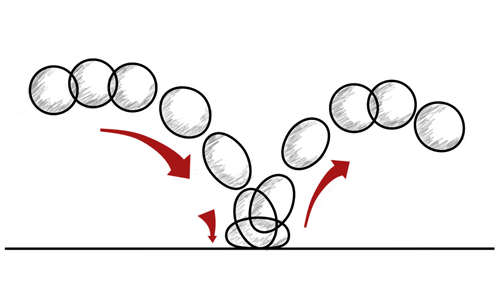
This principle communicates weight and elasticity. Without squash and stretch, objects appear rigid and weightless — they move, but they do not feel like they have physical mass. With it, even a simple geometric shape convinces the viewer that gravity is acting on it.
In brand animation: Used whenever a character or brand element needs to feel physical and real. A button that squashes when pressed feels interactive. A character who stretches toward an exciting discovery feels genuinely animated by emotion. The degree of squash and stretch is calibrated to the desired effect — subtle for realistic characters, exaggerated for comedic or high-energy animation.
2. Anticipation
A movement is preceded by a preparatory motion in the opposite direction. A character bends their knees before jumping. A fist pulls back before swinging.
Anticipation does two things simultaneously: it prepares the viewer’s eye for what is about to happen, and it makes the subsequent action feel more powerful. Without anticipation, motion feels abrupt and mechanical. With it, motion feels intentional and physically grounded.
In brand animation: Used to prepare the viewer for significant visual events — a character about to deliver the key message, a graphic element about to appear, a scene about to transition. In brand animation, subtle anticipation signals communicate emphasis without requiring the viewer to consciously notice the preparation.
3. Staging
The composition of each frame is arranged to direct the viewer’s attention to the most important element at each moment in time.

Staging is the animation equivalent of the director’s shot choice in live film. Every visual decision — where characters stand, what is in the foreground versus background, what moves versus what stays still — is made to ensure the viewer’s eye lands on the right thing at the right moment.
In brand animation: This is the principle most directly relevant to commercial effectiveness. A brand animation in which the CTA appears on screen but is not staged as the visual focal point of the final frames will convert less efficiently than one where the staging actively directs the viewer’s attention to the action prompt. Every frame of a commercial animation should be asked: where should the viewer be looking right now, and is this composition directing them there?
4. Straight Ahead and Pose to Pose
Two different approaches to planning animated motion. Straight ahead means drawing each frame in sequence as the action unfolds. Pose to pose means planning the key positions first, then filling in the frames between them.
These are production techniques as much as aesthetic principles, but their effect on the final animation is visible. Straight-ahead animation produces more spontaneous, fluid, and unpredictable motion. Pose-to-pose animation produces more controlled, precise, and consistent motion.
In brand animation: Most commercial 2D animation uses a hybrid approach — pose-to-pose for structural clarity and consistency, with straight-ahead passes for expressive moments that need organic energy. Understanding this distinction helps clients recognize why spontaneous-feeling motion in a high-quality animation is a deliberate craft choice, not an accident.
5. Follow Through and Overlapping Action
When a primary motion stops, secondary elements — hair, clothing, loose objects — continue moving momentarily before catching up. Different parts of a body start and stop moving at different times.
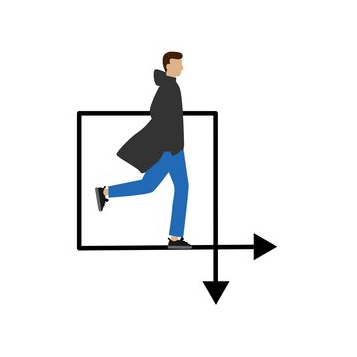
This principle is what makes animated characters feel like they occupy physical space. A character who stops walking and whose hair, coat, and bag all stop at exactly the same moment looks robotic. A character whose coat keeps swaying for two frames after the body stops looks real.
In brand animation: Follow through and overlapping action is one of the clearest quality signals in commercial 2D animation — its presence indicates an animator who is thinking about physical reality, its absence indicates template-based production. For clients evaluating animation quality in a studio’s portfolio, looking for follow through on secondary elements is one of the most reliable diagnostic tests.
6. Slow In and Slow Out (Easing)
Motion accelerates out of a held position and decelerates into the next one. Objects and characters do not move at constant speed — they ease in and ease out.
Constant-speed motion is the signature of mechanical, robotic movement. Living things — and naturally moving objects — accelerate at the start of a motion and decelerate at the end. Easing is the technical implementation of this natural law in animation, and its quality is one of the most reliable indicators of animation craft.
In brand animation: Every graphic element in a brand animation should ease in and ease out of its motion. Text that appears at constant speed feels like a computer output. Text that eases in with a gentle deceleration feels like it was placed with intention. The quality of the easing curves applied to even simple graphic elements distinguishes a polished animation from a generic one.
7. Arcs
Natural living motion follows curved paths rather than straight lines. A hand waves in an arc. A head turns in an arc. A ball thrown through the air follows a parabolic arc.
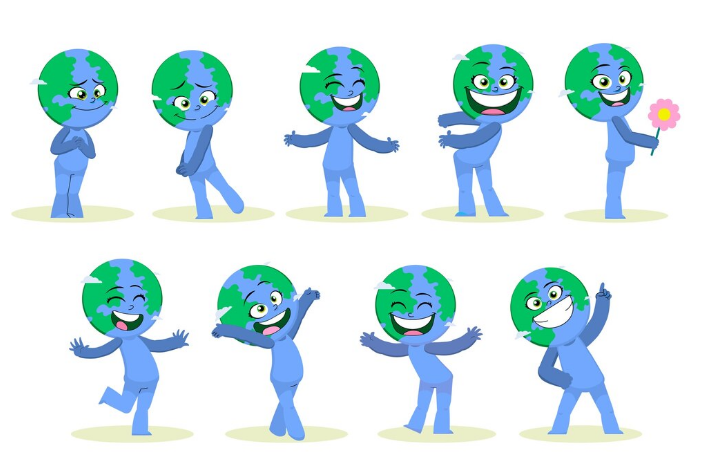
Straight-line motion is the most obvious signal of mechanical rather than organic movement. Humans, animals, and naturally moving objects almost never move in perfectly straight lines — their motion follows the physics of bodies with mass and joints with limited range of motion. Arcs in animation are what make movement feel organic.
In brand animation: In character animation, ensuring that all limb and head movements follow proper arcs is a technical requirement of quality production. In motion graphics, the same principle applies to the movement paths of graphic elements — elements that slide across a screen in a perfectly straight line feel mechanical, while elements that follow a slight curve feel designed.
8. Secondary Action
Supporting movements that add depth and character to the primary action without distracting from it. A character talking and gesturing as a secondary action while walking as the primary action.
Secondary actions make characters feel multidimensional — like complete beings with habits, personalities, and physical tendencies rather than puppets executing a single commanded movement. The key constraint is that secondary actions must support rather than compete with the primary action.
In brand animation: Secondary actions in brand animation create character depth and memorability. A brand character who scratches their head while thinking, or who straightens their posture when delivering good news, becomes a more fully realized personality than one who simply moves to deliver information. These small secondary behaviors are often what viewers remember and what makes a character feel like someone rather than something.
9. Timing
The number of frames devoted to any action determines its perceived speed, weight, and emotional quality. More frames means slower, heavier, more considered. Fewer frames means faster, lighter, more energetic.

Timing is the dimension of animation that viewers feel most strongly and understand least consciously. It is the animator’s primary expressive tool — the difference between a comic beat and a missed joke is often a single frame. Between a moment of drama and a moment that falls flat. Between a transition that feels right and one that feels wrong.
In brand animation: For brand animation, timing decisions communicate brand personality as powerfully as visual style. A brand animation with quick, tight timing feels energetic and confident. One with slower, more spacious timing feels considered and premium. The timing of the CTA reveal — how long it is held on screen, how quickly it arrives — directly affects conversion. Timing is not a production detail. It is a strategic communication decision.
10. Exaggeration
Motion, expression, and action are amplified beyond strict physical realism to increase emotional impact and clarity of communication.
Exaggeration does not mean making things cartoonish — it means making the emotional content of every action unmistakably clear. In realistic animation, a character might be slightly sad. In well-applied exaggeration, the same character’s sadness is readable from across the room. The degree of exaggeration is calibrated to the style and tone of the production.
In brand animation: Exaggeration in brand animation serves clarity. A character who is excited about a product should be visibly, unambiguously excited — their eyes widen, their posture opens, their movement becomes energetic. Underplayed emotional expression in brand animation produces characters who feel passive and unconvincing. The appropriate degree of exaggeration depends entirely on the brand’s tone: premium lifestyle brands use subtle exaggeration while consumer brands aimed at broad audiences may use more pronounced expressions.
11. Solid Drawing
Characters and objects are drawn with a convincing sense of three-dimensional form, weight, balance, and anatomical logic — even in a flat, two-dimensional medium.

Solid drawing is what separates characters that feel like they occupy space from characters that feel like flat shapes. A character with solid drawing has a spine, a center of gravity, joints that work in anatomically logical ways, and a physical presence in the frame. Without it, characters feel two-dimensional in the worst sense — flat, unstable, and unconvincing.
In brand animation: In commercial brand animation, solid drawing most directly affects the credibility and likability of brand characters. A character with strong solid drawing reads as a believable personality. One without it reads as clip art. This is why custom character design — as opposed to using stock character libraries — is such a significant quality differentiator in brand animation: custom-designed characters are built with solid drawing principles from the outset.
12. Appeal
Characters, designs, and animations are created with the intention of engaging the audience’s interest and sympathy. Appeal does not mean cute or likeable — it means visually and emotionally interesting.
Appeal is the most subjective of the twelve principles and simultaneously the most commercially relevant. A character with appeal is one the viewer wants to spend time with, wants to follow through a narrative, wants to see succeed. This quality is created through the combination of design, expression, movement, and personality — and it is immediately recognizable when it is present and immediately conspicuous when it is absent.
In brand animation: For brands, appeal in animation characters is a brand asset. A brand character with genuine appeal generates audience connection that extends beyond any single video — viewers begin to recognize and engage with the character across platforms and touchpoints. Appeal is not an accident: it is designed deliberately through character design decisions, movement choices, and personality behaviors that collectively create a being the audience cares about.
The twelve principles collectively describe the conditions under which a viewer suspends disbelief and accepts that a drawn image is alive. Every professional 2D animator applies them in every frame. Every client who understands them can evaluate animation quality and give more useful creative feedback.
How the Principles Apply to Your Next Animation Project
For brand owners and marketing leads, the twelve principles are most useful as an evaluative framework rather than a production checklist. You are not going to direct an animator through their application of easing curves or secondary action — but you are equipped to recognize when these principles are being honored and when they are being ignored.
When you watch a piece of animation and it feels alive, believable, and engaging without your being able to articulate why — the twelve principles are working. When you watch an animation and it feels mechanical, flat, or unconvincing despite attractive visuals — one or more principles are being violated. Asking a studio to walk you through a piece in their portfolio and explain how they applied principles like timing, secondary action, and staging is one of the most revealing quality assessment conversations you can have before committing to a production partner.
2D Animation Studio applies all twelve principles on every project as a matter of craft — not compliance. If you would like to see how they show up in our work, we are happy to walk you through any piece in our portfolio. Reach out to start a conversation.
Frequently Asked Questions About the 12 Principles of Animation
Q1: Do all 12 principles apply to every type of 2D animation?
All twelve principles apply to character animation in full. For motion graphics and typographic animation — where there are no characters, only abstract shapes and text — the character-specific principles (solid drawing, appeal, secondary action as it applies to body language) are less directly applicable, though analogous concepts apply. Easing, timing, staging, arcs, anticipation, and follow through apply to every type of animated motion, including non-character animation. The principles are descriptions of how natural physical motion and human perception work — they apply wherever motion is used to communicate, regardless of whether the moving element is a human character or a typographic element.
Q2: How do the principles relate to the difference between good and bad animation?
The twelve principles collectively describe the conditions under which animation creates a convincing illusion of life. Animation that violates or ignores these principles — regardless of how technically proficient the rendering is — feels mechanical, weightless, or unconvincing. The most common violations in lower-quality commercial animation are: absent or weak easing (constant-speed motion), no follow through or secondary action, staging that does not direct the viewer’s attention clearly, and exaggeration that is either non-existent (flat, unexpressive characters) or arbitrary (exaggeration without emotional logic). These violations are detectable by any viewer, even those who cannot name the principle being violated — they register as the animation simply not feeling right.
Q3: Were the 12 principles invented by Disney, or were they already known?
The principles were developed by Disney animators through practice rather than theoretical study — they are empirical observations about what works, accumulated through decades of production. However, many of the underlying perceptual phenomena the principles describe were already studied in the fields of psychology and physics of motion before Disney’s animators codified them in the context of animation. The principles are not Disney’s intellectual property — they are descriptions of natural perceptual phenomena that Disney’s animators were the first to systematically articulate in an animation production context. They were formalized by Johnston and Thomas in their 1981 book and have since become the universal technical foundation of animation education worldwide, entirely independent of Disney as a company.
Q4: Do digital animation tools automatically apply the 12 principles?
No — and this is one of the most common misconceptions about modern animation production. Digital animation software provides tools that make applying the principles easier (easing curve editors, secondary physics simulations, onion-skinning for arc checking), but applying them well still requires skilled human judgment. Software can generate motion between keyframes automatically, but it cannot determine whether that motion has the right timing, the right degree of anticipation, or the right secondary follow through for the creative intent of the specific scene. The principles are craft decisions made by the animator — the software is the instrument, not the musician. Template-based animation tools that promise professional results without animator expertise produce animations that violate most of the twelve principles systematically, which is why they are immediately recognizable as template-based to trained eyes.
Q5: How can I use the 12 principles when reviewing animation work in progress?
The most practical application of the principles during a client review is as a diagnostic framework for understanding why something feels off. If a character’s movement feels robotic, ask whether easing is being applied — are elements accelerating and decelerating naturally, or moving at constant speed? If a transition feels abrupt, ask whether anticipation was used. If secondary elements feel stiff, ask whether follow through is present. If a frame feels visually confusing, ask whether staging is directing attention appropriately. You do not need to use the technical vocabulary in your feedback — ‘the character’s coat should keep swaying for a moment after she stops walking’ is a description of follow through that any animator will understand. But knowing the principles gives you the conceptual framework to diagnose the gap between what you are seeing and what you want to see.
Q6: Are there any new animation principles developed since Johnston and Thomas’s original 12?
The core twelve principles have remained stable as the foundational framework of animation craft since their publication in 1981. However, the digital era has generated supplementary principles and best practices specific to digital animation production: the management of easing curves in software, the use of physics simulations for secondary motion, principles of UI animation and micro-interaction design, and the specific constraints of animation for social media formats and compressed video. These additions extend and contextualize the original principles for new production environments but do not supersede them. The twelve principles describe fundamental properties of human perception and physical motion — domains that do not change with technology — which is why they remain as relevant to a rigged character animation produced in Toon Boom Harmony in 2026 as they were to a hand-drawn cel animation produced at the Disney studio in 1937.
2D Animation Studio brings craft-level knowledge of the twelve principles to every project we produce. Our animators do not treat them as a checklist — they apply them as instinct, developed through years of professional practice. Reach out to discuss your animation brief and see the difference craft makes.