Frame-by-Frame vs. Rigged 2D Animation: Which Technique Fits Your Project?
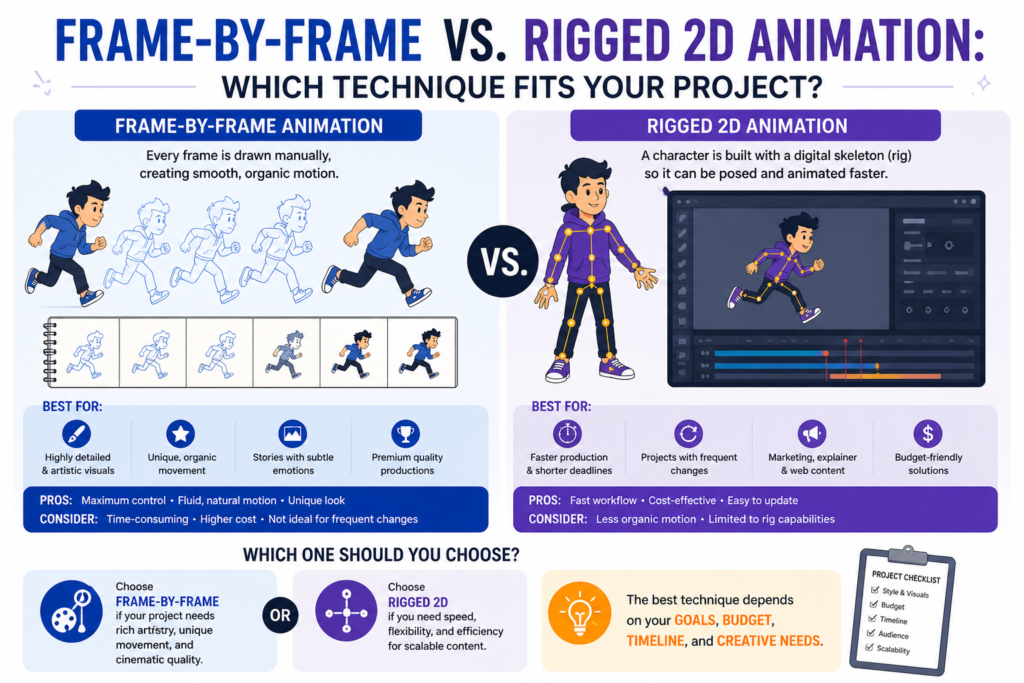
When you commission a 2D animation, you are making dozens of decisions: style, duration, voiceover, music, platform. But one of the most consequential decisions — one that affects cost, timeline, visual quality, and long-term flexibility — often goes undiscussed entirely: the animation technique. There are two fundamental approaches to producing 2D animated characters and movement. Frame-by-frame animation, in which each individual frame is drawn from scratch, and rigged animation (also called cut-out or puppet animation), in which a set of pre-drawn character parts is assembled, connected, and posed using a digital skeletal system. Both techniques are capable of producing outstanding work. Both have significant trade-offs. And understanding the difference is the key to making a smarter brief — and getting a better result from your animation partner. The technique is not just a production detail. It shapes the look, the cost, the timeline, and the long-term value of your animated content investment. What Is Frame-by-Frame Animation? Frame-by-frame animation — also called traditional animation or hand-drawn animation in its digital form — is the technique in which every single frame of the animation is drawn as a unique image. At standard film and video rates, that means 24 individual drawings for every second of finished animation. A 90-second explainer video produced entirely in frame-by-frame technique requires a minimum of 2,160 individual drawings, each slightly different from the last to create the illusion of motion. In the pre-digital era, these drawings were made on paper and then transferred to celluloid. Today, the process is performed digitally using drawing tablets and software like Toon Boom Harmony, Adobe Animate, or TVPaint. The medium has changed; the fundamental process has not. The animator draws every frame. The Distinctive Visual Quality of Frame-by-Frame The reason studios and directors choose frame-by-frame animation despite its higher cost and longer timelines is the visual quality it produces. Because each frame is individually drawn, the motion has an organic, slightly imperfect quality — lines breathe, forms shift subtly, and the sense of hand-made craftsmanship is unmistakable. This quality communicates effort, artistry, and premium value in a way that rigged animation typically cannot replicate. Great frame-by-frame animation has weight, personality, and a particular kind of aliveness that audiences respond to viscerally. The fluid smear frames — frames that intentionally distort character forms to convey speed and energy — are impossible to achieve with a rigid rig. The textural richness of a fully hand-animated scene is unmatched in the 2D medium. The Real Costs and Trade-Offs Frame-by-frame animation is, without qualification, the most labor-intensive form of 2D production. The time required per second of finished animation is 5 to 10 times greater than for equivalent rigged animation. This translates directly into cost: a professionally produced frame-by-frame animated short can cost two to four times more than a rigged animation of the same length. Revisions are also significantly more complex. If a client requests a change to a character’s movement in frame-by-frame animation, the affected frames must be redrawn individually. In rigged animation, the same change might require adjusting a few keyframe poses. For commercial projects where client feedback and iteration are expected, this distinction has real budgetary consequences. What Is Rigged (Cut-Out) Animation? Rigged animation — sometimes called cut-out animation or puppet animation — takes a fundamentally different approach. Rather than drawing every frame from scratch, the animator begins by building a complete set of character assets: a head, a body, arms, legs, hands, and facial features, all drawn as separate illustrated pieces. These pieces are then assembled in animation software and connected using a digital skeleton — a hierarchy of joints that defines how each part of the body can move relative to the others. Animation is then created by posing the rig at key moments in time (keyframes) and letting the software interpolate the movement between poses. The animator adjusts timing, easing, and secondary movement to create the final motion. The character assets are drawn once and reused for the entire production — and potentially for future productions featuring the same character. Why Rigged Animation Dominates Commercial 2D Production The vast majority of commercial 2D animation produced today — explainer videos, animated ads, social media content, educational videos — uses rigged animation. The economic rationale is straightforward: it is faster, cheaper, and more scalable. A rigged character can be posed and repositioned in a fraction of the time required to draw equivalent motion frame by frame. Rigged animation also offers significant advantages for brand consistency. Once a character is designed and rigged, it maintains consistent proportions, features, and style across every scene and every future production. For brands that want to build an animated character system — a recurring cast of characters used across marketing, product, onboarding, and social content — rigged animation is the only practical approach. The Honest Limitations of Rigged Animation The trade-off for speed and scalability is expressiveness. A rigged character moves within the constraints of its rig — the number of joints, the range of motion designed into each limb, the pre-drawn expressions available for the face. For simple, clear motion — a character walking, gesturing, turning to face the camera — a well-built rig produces excellent results. For highly expressive, physically complex, or stylistically distinctive motion, rigged animation has ceiling limitations that frame-by-frame does not. Rigged animation can look mechanical when produced carelessly. The hallmark of poor rig work is motion that feels stiff and uniform — characters that slide rather than walk, arms that swing robotically rather than naturally. An experienced animator working with a well-built rig can largely overcome these limitations through careful timing, layered secondary motion, and strong anticipation and follow-through. But skill level matters enormously in rigged animation, perhaps more than in frame-by-frame, where the quality of the drawing itself carries much of the expressive weight. Side-by-Side: Frame-by-Frame vs. Rigged Animation The following comparison covers the most important production and strategic factors for brands choosing between techniques. Factor Frame-by-Frame Rigged / Cut-Out Production Speed Slow — every frame drawn