When you commission a 2D animation, you are making dozens of decisions: style, duration, voiceover, music, platform. But one of the most consequential decisions — one that affects cost, timeline, visual quality, and long-term flexibility — often goes undiscussed entirely: the animation technique.
There are two fundamental approaches to producing 2D animated characters and movement. Frame-by-frame animation, in which each individual frame is drawn from scratch, and rigged animation (also called cut-out or puppet animation), in which a set of pre-drawn character parts is assembled, connected, and posed using a digital skeletal system. Both techniques are capable of producing outstanding work. Both have significant trade-offs. And understanding the difference is the key to making a smarter brief — and getting a better result from your animation partner.
The technique is not just a production detail. It shapes the look, the cost, the timeline, and the long-term value of your animated content investment.
What Is Frame-by-Frame Animation?
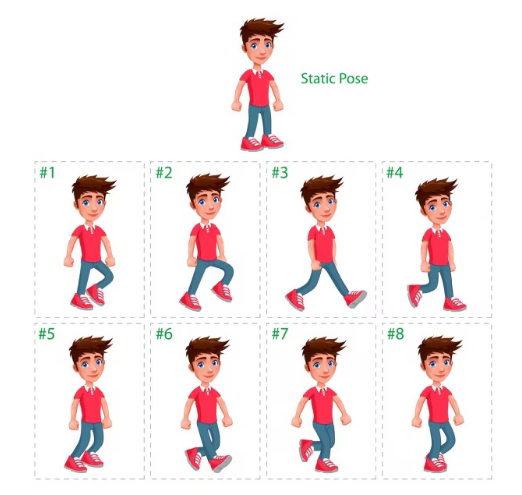
Frame-by-frame animation — also called traditional animation or hand-drawn animation in its digital form — is the technique in which every single frame of the animation is drawn as a unique image. At standard film and video rates, that means 24 individual drawings for every second of finished animation. A 90-second explainer video produced entirely in frame-by-frame technique requires a minimum of 2,160 individual drawings, each slightly different from the last to create the illusion of motion.
In the pre-digital era, these drawings were made on paper and then transferred to celluloid. Today, the process is performed digitally using drawing tablets and software like Toon Boom Harmony, Adobe Animate, or TVPaint. The medium has changed; the fundamental process has not. The animator draws every frame.
The Distinctive Visual Quality of Frame-by-Frame
The reason studios and directors choose frame-by-frame animation despite its higher cost and longer timelines is the visual quality it produces. Because each frame is individually drawn, the motion has an organic, slightly imperfect quality — lines breathe, forms shift subtly, and the sense of hand-made craftsmanship is unmistakable. This quality communicates effort, artistry, and premium value in a way that rigged animation typically cannot replicate.
Great frame-by-frame animation has weight, personality, and a particular kind of aliveness that audiences respond to viscerally. The fluid smear frames — frames that intentionally distort character forms to convey speed and energy — are impossible to achieve with a rigid rig. The textural richness of a fully hand-animated scene is unmatched in the 2D medium.
The Real Costs and Trade-Offs
Frame-by-frame animation is, without qualification, the most labor-intensive form of 2D production. The time required per second of finished animation is 5 to 10 times greater than for equivalent rigged animation. This translates directly into cost: a professionally produced frame-by-frame animated short can cost two to four times more than a rigged animation of the same length.
Revisions are also significantly more complex. If a client requests a change to a character’s movement in frame-by-frame animation, the affected frames must be redrawn individually. In rigged animation, the same change might require adjusting a few keyframe poses. For commercial projects where client feedback and iteration are expected, this distinction has real budgetary consequences.
What Is Rigged (Cut-Out) Animation?
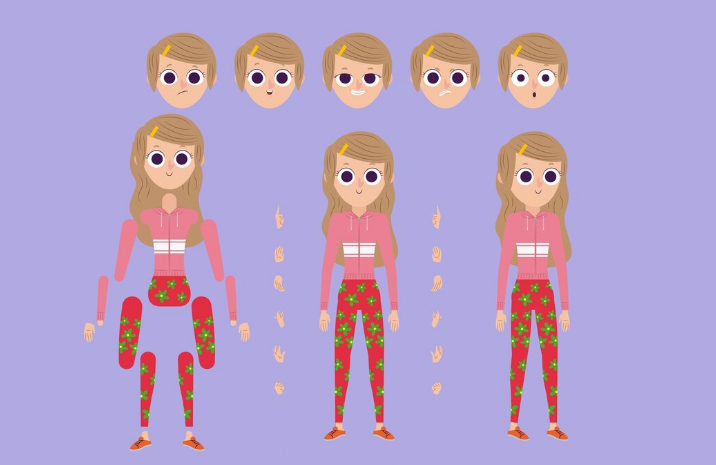
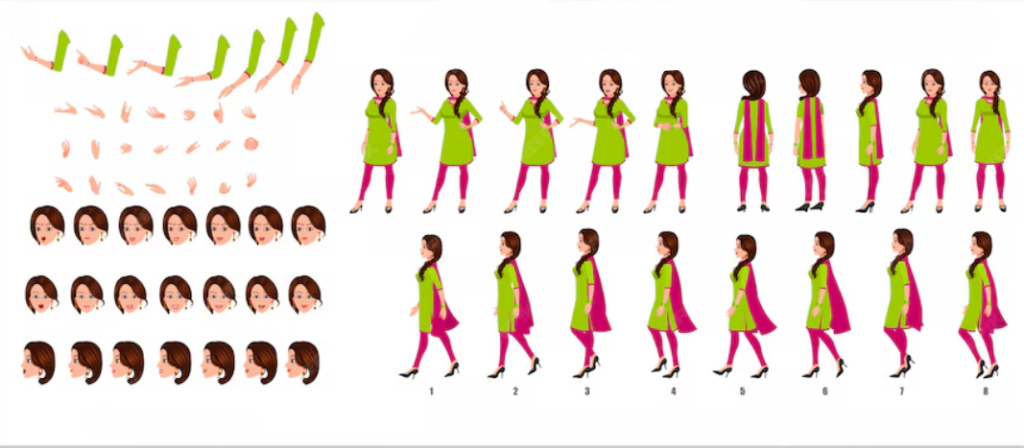
Rigged animation — sometimes called cut-out animation or puppet animation — takes a fundamentally different approach. Rather than drawing every frame from scratch, the animator begins by building a complete set of character assets: a head, a body, arms, legs, hands, and facial features, all drawn as separate illustrated pieces. These pieces are then assembled in animation software and connected using a digital skeleton — a hierarchy of joints that defines how each part of the body can move relative to the others.
Animation is then created by posing the rig at key moments in time (keyframes) and letting the software interpolate the movement between poses. The animator adjusts timing, easing, and secondary movement to create the final motion. The character assets are drawn once and reused for the entire production — and potentially for future productions featuring the same character.
Why Rigged Animation Dominates Commercial 2D Production
The vast majority of commercial 2D animation produced today — explainer videos, animated ads, social media content, educational videos — uses rigged animation. The economic rationale is straightforward: it is faster, cheaper, and more scalable. A rigged character can be posed and repositioned in a fraction of the time required to draw equivalent motion frame by frame.
Rigged animation also offers significant advantages for brand consistency. Once a character is designed and rigged, it maintains consistent proportions, features, and style across every scene and every future production. For brands that want to build an animated character system — a recurring cast of characters used across marketing, product, onboarding, and social content — rigged animation is the only practical approach.
The Honest Limitations of Rigged Animation
The trade-off for speed and scalability is expressiveness. A rigged character moves within the constraints of its rig — the number of joints, the range of motion designed into each limb, the pre-drawn expressions available for the face. For simple, clear motion — a character walking, gesturing, turning to face the camera — a well-built rig produces excellent results. For highly expressive, physically complex, or stylistically distinctive motion, rigged animation has ceiling limitations that frame-by-frame does not.
Rigged animation can look mechanical when produced carelessly. The hallmark of poor rig work is motion that feels stiff and uniform — characters that slide rather than walk, arms that swing robotically rather than naturally. An experienced animator working with a well-built rig can largely overcome these limitations through careful timing, layered secondary motion, and strong anticipation and follow-through. But skill level matters enormously in rigged animation, perhaps more than in frame-by-frame, where the quality of the drawing itself carries much of the expressive weight.
Side-by-Side: Frame-by-Frame vs. Rigged Animation
The following comparison covers the most important production and strategic factors for brands choosing between techniques.
| Factor | Frame-by-Frame | Rigged / Cut-Out |
| Production Speed | Slow — every frame drawn individually | Fast — rigs allow quick repositioning |
| Cost | Higher — more labor hours per second | Lower — same assets reused across scenes |
| Visual Fluidity | Exceptional — organic, natural motion | Good — fluid when well-rigged, mechanical if rushed |
| Character Consistency | Challenging — varies frame to frame | Excellent — consistent proportions guaranteed |
| Revisions | Difficult — redrawing multiple frames | Easy — adjust rig poses without redrawing |
| Best For | Premium brand films, title sequences, artistic storytelling | Explainers, social content, commercial animation, recurring characters |
| Scalability | Low — each new scene requires full effort | High — character library scales across projects |
The Hybrid Approach: Combining Both Techniques
The most sophisticated commercial 2D animation often uses both techniques deliberately within a single production. A rigged character might walk or gesture using the rig for efficiency, while a moment of high emotional impact — a fall, a burst of joy, a dramatic reaction — is animated frame by frame for maximum expressiveness. This hybrid approach is standard practice in premium animation studios and represents the best of both worlds when the budget allows for it.
Identifying which moments in a production warrant frame-by-frame treatment and which can be efficiently handled with a rig is one of the most valuable skills a production director or lead animator brings to a project. It is also one of the clearest indicators of a studio’s experience level — inexperienced studios either animate everything the same way, or frame everything as an either/or choice rather than a contextual one.
The most compelling commercial 2D animation uses technique as a storytelling tool — deploying frame-by-frame at moments of emotional peak, and rigged animation for efficient narrative exposition.
Which Technique Is Right for Your Brand’s Project?
The answer depends on four variables: your budget, your timeline, your quality expectations, and your intended use case. Here is a practical framework for making the decision.
Choose Frame-by-Frame When…
- You are producing a high-profile brand film or launch video where visual distinctiveness is a strategic priority.
- The animation is intended to earn attention and press coverage based on craft quality alone.
- Your brand occupies a premium market position and the animation must communicate that positioning visually.
- You have a flexible timeline of 8–14 weeks and a budget that reflects the additional production labor.
- The content involves highly expressive character acting, complex physical movement, or organic natural environments.
Choose Rigged Animation When…
- You need a professional, high-quality result within a defined budget and a 4–6 week timeline.
- You are producing an explainer video, social media content, animated ads, or educational animation.
- You want to build a reusable character or cast that will appear across multiple future productions.
- The content involves clear, communicative movement — characters explaining, demonstrating, or guiding — rather than complex expressive performance.
- You anticipate revisions and want the flexibility to adjust the animation without rebuilding scenes from scratch.
Choose a Hybrid Approach When…
- You are producing a brand film or premium explainer with a quality-focused brief and a mid-to-high budget.
- There are specific moments of emotional peak that warrant maximum expressiveness within an otherwise efficiently produced piece.
- Your studio has the production depth to manage both techniques within a single pipeline without introducing quality inconsistency.
2D Animation Studio works across frame-by-frame, rigged, and hybrid 2D techniques — matching the production approach to the creative and commercial requirements of every project. Speak with our team to determine the right technique for your animation brief.
Frequently Asked Questions: Frame-by-Frame vs. Rigged 2D Animation
Q1: Is frame-by-frame animation always higher quality than rigged animation?
Not necessarily — the relationship between technique and quality is more nuanced than that. Frame-by-frame animation has a higher ceiling for expressive, organic motion, but poorly executed frame-by-frame animation will look worse than well-executed rigged animation. A skilled animator working with a high-quality, purpose-built rig can produce 2D animation that is indistinguishable in quality from frame-by-frame to most viewers in most contexts. The technique is a tool, not a quality guarantee. What determines quality is the skill of the animator, the quality of the character design and rigging, and the care taken in timing and secondary animation — regardless of technique.
Q2: How much more expensive is frame-by-frame animation compared to rigged animation?
For equivalent duration and complexity, frame-by-frame animation typically costs two to four times more than rigged animation. The precise multiplier depends on the frame rate, the complexity of the movement, and the style of illustration. A 60-second piece that costs $6,000–$10,000 as rigged animation might cost $18,000–$35,000 if produced entirely frame by frame. For most commercial brand video applications — explainers, social content, educational animation, and animated ads — the additional investment in frame-by-frame technique does not proportionally increase commercial effectiveness. The premium is most justified when the brand value of craft quality is a strategic priority.
Q3: Can a rigged character be converted to frame-by-frame animation later?
Yes, though it is a labor-intensive process that essentially involves producing the frame-by-frame version from scratch using the rigged character as a reference. It is not a straightforward technical conversion. In practice, studios that need to upgrade specific scenes within a rigged production to frame-by-frame quality will re-animate those scenes individually, using the original character design as the style reference. This is one reason why having a well-documented character design system — a style guide that defines proportions, features, and range of expression — is important even for rigged animation projects that may eventually incorporate hand-drawn sequences.
Q4: What software is used for each technique?
Frame-by-frame digital animation is most commonly produced using Toon Boom Harmony, TVPaint, or Adobe Animate — software designed to support high-volume frame drawing, line quality control, and traditional animation workflows. Rigged animation is produced primarily in Toon Boom Harmony (which supports both techniques), After Effects with character rigging plugins like Duik or Joysticks n’ Sliders, and Spine (particularly for game animation). Some studios use a hybrid pipeline: designing and rigging characters in Toon Boom Harmony, and rendering final compositing in After Effects. The software choice reflects both the studio’s expertise and the specific requirements of the production.
Q5: Does the technique affect how the animation looks on different platforms?
The technique itself does not affect platform compatibility — both frame-by-frame and rigged animation are rendered and delivered as standard video files (MP4, MOV, GIF) that work identically across all platforms. The technique does, however, affect how the animation reads at different sizes and compression levels. Frame-by-frame animation with fine detail and subtle line variation can lose quality when compressed for low-bandwidth platforms or displayed at small sizes. Rigged animation with clean, graphic shapes and bold color areas tends to compress and scale more robustly. For social media content in particular — where videos may be watched at small size on mobile devices — the cleaner geometric quality of well-executed rigged animation can sometimes read better than the subtler qualities of frame-by-frame work.
Q6: How do I communicate my technique preference to an animation studio?
The most effective way is to provide visual references — examples of animations you like that demonstrate the quality and movement style you are looking for. If you can identify whether those reference examples feel more hand-drawn and organic (likely frame-by-frame) or more graphic and precise (likely rigged), you can communicate that distinction directly. You can also describe the feeling you want the animation to convey: a studio will hear ‘premium, artisanal, handcrafted’ differently from ‘clean, precise, professional.’ If you are unsure, describe your goal and budget range and let the studio recommend the technique — an experienced team will tell you honestly what each approach can achieve within your parameters.
2D Animation Studio produces frame-by-frame, rigged, and hybrid 2D animation for US brands across every industry. If you are preparing a brief and want expert guidance on which technique fits your project, reach out — our team is happy to advise before you commit to a direction.